
মাসুম হাসান
সিনিয়র শিক্ষক

২৭ সেপ্টেম্বর, ২০২৪ ০১:৪৩ অপরাহ্ণ
সিনিয়র শিক্ষক
A professional English teacher must find this sheet extraordinary.
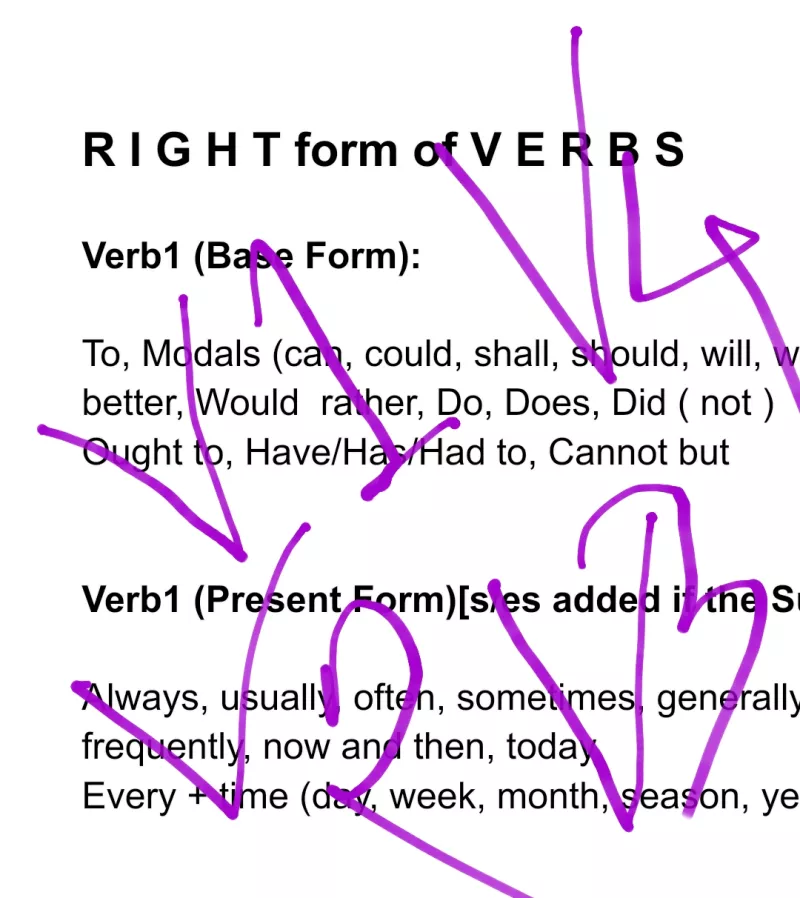
R I G H T form of V E R B S
Verb1 (Base Form):
To, Modals (can, could, shall, should, will, would, may, might, dare, need, must, let), Had better, Would rather, Do, Does, Did ( not )
Ought to, Have/Has/Had to, Cannot but
Verb1 (Present Form)[s/es added if the Subject is 3rd person singular number)
Always, usually, often, sometimes, generally, daily, occasionally, normally, at times, as usual, frequently, now and then, today.
Every + time (day, week, month, season, year, era, century)
Verb 2 (Past Form) :
Yesterday, ago, long ago, once, then, at that time, long since, in the past,
Wish, fancy, it is time, it is high time, before,
Last + time ( day, night, week, month, season, year, era, century)
Incidents of past, history, and dead man.
Verb 3 (Past Participle):
To Have ( have, has, had, having )
To Be (am, is, are, was, were, be, been, being), Get, got, getting.
(have/has + V3 ):
Recently, lately, already, yet, by this time, in the meantime, meanwhile, just, just now
Verb 4 [Present Participle] (ing ):
Prepositions (of for from on in into before after by with without through at…....)
With a view to, with an eye to, look forward to, get/be used to, addicted to, devoted to, prefer to, habituated to, mind, would you mind, can/could not help, worth, past, while, It is no use
(Am/is/are + V+ing):
now, in this moment, at present, day by day
Structural Forms
1. If/ Unless + Sub + V1 > Sub + shall/will + V1 + Ext.
Ex: If you study well, You will make a good result.
2. If/ Unless + Sub + V2 > Sub + would/could + V1 + Ext.
Ex: Unless he went there, I could not meet him.
3. If/ Unless + Sub + had + V3 > Sub + would/could have + V3
Ex: If you had written the letter, I would have posted it.
4. Had + Sub + V3 > Sub + would/could have + V3 + Ext.
Ex: Had she seen the bird, she would have caught it.
5. Sub + V1 + since/as if/as though > Sub + V2 + Ext.
Ex: It is many years since I saw him.
6. Sub + V2 + since/as if/as though > Sub + had + V3 + Ext
Ex: It was dark as if we had seen nothing.
7. Sub + V1 + as if/as though + Sub + (be) > were.
Ex: She laughs as though she were frantic.
8. Sub + V1/V2 + ext + lest > Sub + should/might + V1 + Ext
Ex: He ran fast lest he should miss the train.
9. Would that + Sub > could + V1+ Ext.
Ex: Would that I could earn a lot of money!
10. Sub + Verb + so that > S + can/could + V1 + ext.
Ex: We eat food so that we can/may live well.
11. No sooner had + S + V3 + ext >than+ Sub + V2+ ext.
Ex: No sooner had I seen him than I met him.
12. Scarcely/hardly had+S+V3> when + Sub + V2 + ext.
Ex: Hardly had we gone home when the rain came.
13. It is time/ it is high time > Sub + Verb2 + Ext.
Ex: It is high time Amrita came back to me.
14. Sub + V + so + adj/adv + that > S + can/could+not+V1+ext
Ex: You are so studious that you cannot fail in the exam.
15. Sub +had better> Verb1 + ext.
Ex: Police had better find out the criminals at first.
16. Sub + would rather > Verb1 + than + Verb1 + ext.
Ex: Dipannita would rather suicide than marry at teenage
17.
Principal Clause
Present/Future Tense = >Sub ordinate Clause - Simple Past Tense (Sub + Verb 2)
Other Tense = > Past Ind/con/per or Present
18. Sub + Verb2 + ext + after > Sub + had + Verb3 + ext.
Ex: She reached home after I had gone away.
19. Sub + had + Verb3 + before + Sub + Verb2 + ext
Ex: He had seen me before I met him.
20. While + Sub > was/were + Verb + ing + ext.
Ex: I saw a dead cow while I was walking along the road.
21. Sub + Verb + Adj + enough > to + Verb1 + ext
Ex: You are strong enough to carry the load.
22. Let alone > Dissimilar word
Ex: He cannot walk a mile let alone ten miles
23. Since/As/When/Though/Although + Past Tense > Past Ind./Con./Per. Tense
Ex: Since you knew the place, you reached there first of all.
As he ate a lot of foods, he was feeling sick.
When you came home, mother was cooking then.
Though they promised to play well, they had forgotten the promise.
24. Would you mind > Verb + ing + ext.
Ex: Would you mind opening the window?
25. Sub + Verb + too + Adj > to + Verb1 + ext
Ex: You are too weak to work now.
Agreement between Subject & Verb
Singular verb: Generally follows a singular SUBJECT.
Plural Verb: Generally follows a plural SUBJECT.
Singular verbs: Is, was, has, had, Verb + s/es
Plural Verbs: Are, were, have, had, Verb (Without s/es)
R -1: There are some plural nouns that take plural verbs: Scissors, optics, spectacles, wages,
asset, ashes, alms, amends, trousers, shorts, glasses, pants, shoes, thanks, aborigines.
R -2: a) Two subjects connected with ‘and’ take a plural verb.
Rubel and Rashel are brothers; Pen and pencil have been bought.
b) If the two subjects express the same think or concept, they take a sing. Verb.
Slow and steady wins the race.
c) If ‘The’ is used once: sing. Verb; If twice: plural verb.
The MP and Minister calls a meeting; The poet and the novelist are present.
R -3: Indefinite pronouns such as– Anybody, Anyone, Anything, Somebody, Someone,
Something, Everybody, Everyone, Everything, Nobody, No one, None, Nothing, One of ,
Each of , Every of , Each, Every etc. always take Singular Verb.
Ex: Nothing appeals me much. Everybody admires a beautiful thing.
R -4: When two subjects are connected with – With, together with, along with, as well as,
accompanied by, in addition to, and not; then the verb follows the first sub.
Ex: Pritom along with his brothers is conscious of health.
Some robbers and not the thief have ransacked the house.
R -5: Some nouns seem to be plural but they are singular: Mathematics, News, Physics, Politics,
whereabouts, gallows, statistics, Dynamics; So they take Singular verb.
Ex: My whereabouts is not good at all.
R -6: Some nouns seem to be singular but they are plural : People, Public, Mankind, folk, Gentry,
cattle, Vermin, Aristocrat, Nobility, Poultry, Peasantry, Dozen etc. So, they take Plural verb.
Ex: Mankind have lost their value;
Vermin are spoiling the corn field.
R -7: Name of Book, Novel, Poem, Film, Story, Newspaper, Country, Drama etc. may be plural
but they take singular verb.
Ex: Loves for Cathedral is a great story.
R -8: Infinitive, Gerund, Verbal noun, Clause, Phrase, Dozen (ph), Pair, Hundred, Thousand, Score,
etc take Sing. Verb.
Ex: Writing letters is his hobby
A Pair of shoes was on the floor.
R-9: The +Adj. generally takes a plural verb because it means a group.
Ex: The honest are properly happy.
R-10: Certain Time, Distance, Money, Age, Weight etc. always take a singular verb.
Ex: 10 years was his age.
R-11: When two subjects are connected with or, nor, either... or, neither.... nor, not only..... but
also, then the verb follows the 2nd subject .
Ex: Either he or his parents were present.
Neither she nor her mother has gone there.
R- 12 ‘There’ & ‘here’ follow the noun set after the verb.
Ex: There were many people.
There was a tree. Here comes the doctor.
R- 13. Agree, Attempt, Claim, decide, demand, desire, expect, fail, forget, hesitate, hope,
intend, learn, need, offer, promise, plan, prepare, refuse, strive, tend, want, wishà
Infinitive (to + V1)
Ex: We attempted to touch the roof.
R- 14. Admit, enjoy, report, appreciate, finish, avoid, mind, resist, miss, resume, consider, risk,
delay, practice, suggest, deny, quit, stop, prefer, like, feel like, mind, enjoyà verb + ing
Ex: They delayed reaching the place.
R- 15. S + get /Have/want/ + object = Verb3
Ex: Amrita got her food cooked.
R- 16. For /since + Time = S + have been/has been + V + ing.
Ex: The man has been working here for three hours
People have been waiting at the station since morning.
R- 18. Advised, important, required, mandatory, recommend, urgent, suggested, obligatory,
Proposed, imperative + that + S + V1 (base form).
Ex: It is obligatory that he attend the class.





৬৫
১০০ মন্তব্য