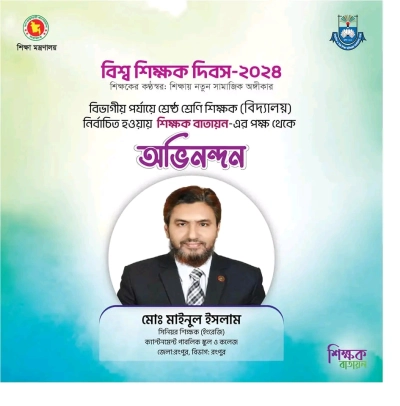
MD MAINUL ISLAM
সিনিয়র শিক্ষক


০৬ জানুয়ারি, ২০২৬ ০২:৫৪ অপরাহ্ণ
সিনিয়র শিক্ষক
How to Apply Mind-Blowing and Fruitful Teaching:
Popular Methods for English Language Teaching in High Schools in Bangladesh
Abstract
Teaching English in high schools can be a fun, engaging, and highly effective process if teachers use the right methods. Teaching English in high schools in Bangladesh is challenging but exciting. Teachers need creative and effective methods to engage students and improve learning outcomes. This paper explores more than 30 popular and important teaching methods, showing how they can be applied fruitfully in classrooms using easy and practical examples. Names like Tanique, Tasfia, and Tabassum are used to demonstrate real-life classroom situations. The research emphasizes student-centred learning, interactive activities, and practical exercises that make learning English enjoyable. This study aims to help teachers, students, and educational planners improve teaching practices in Bangladeshi high schools. By using simple language and creative strategies, English language teaching can be more effective, meaningful, and exciting.
Key Words: Teaching Methods, Communicative Language Teaching (CLT), Task-Based Learning, Grammar-Translation Method
Introduction
English is an essential subject in Bangladeshi high schools. Students need to learn listening, speaking, reading, and writing skills to communicate confidently. However, many students find English difficult because of the traditional methods of teaching. Therefore, teachers need fruitful and mind-blowing teaching methods that make learning simple, engaging, and practical.
This paper will discuss more than 30 teaching methods, with easy explanations and examples. These methods are useful for high school teachers in Bangladesh to improve students’ English skills. Using names like Tanique, Tasfia, and Tabassum, the examples will be practical and relatable for teachers and students.
1. Direct Method
In this method, English is taught through speaking and listening. Students do not use their mother tongue. For example, Tarique is asked to describe his favourite hobby in English without using Bengali. The teacher corrects him gently and encourages him to speak complete sentences. Tasfia practices describing her family, and Tabassum practices asking questions like “What is your favourite food?” This method improves speaking and listening quickly.
2. Communicative Language Teaching (CLT)
CLT focuses on communication. Students work in pairs or groups to complete tasks. For example, Tasfia and Tabassum are given a role-play activity where Tasfia is a shopkeeper and Tabassum is a customer. They practice dialogues like “How much is this book?” This method helps students use English in real-life situations.
3. Task-Based Learning
Students learn by doing tasks. Tarique is asked to write a short story about his last holiday. Tasfia is asked to make a poster in English about saving water. Tabassum is asked to give a 2-minute talk on her favourite animal. Tasks make learning meaningful and memorable.
4. Grammar-Translation Method
This traditional method focuses on grammar rules and translation. For example, the teacher explains how to use past tense verbs. Tarique translates sentences like “I went to the market yesterday” from Bengali to English. Though it is not very interactive, it helps students understand grammar clearly.
5. Audio-Lingual Method
Students listen to dialogues and repeat sentences. For example, Tasfia listens to a dialogue: “Hello! How are you?” and repeats it several times. Tabassum practices questions and answers in the same way. This method improves pronunciation and fluency.
6. Total Physical Response (TPR)
TPR uses actions with words. The teacher says “Stand up” and Tarique stands up. “Sit down” and Tasfia sits. Tabassum jumps when the teacher says “Jump.” This method is very helpful for beginners to remember words and commands easily.
7. Silent Way
In the Silent Way, the teacher speaks very little. Students take the lead. For example, the teacher points to a picture of a cat, and Tarique says “cat.” Tasfia then describes it: “The cat is black.” Tabassum makes a sentence: “The cat is sleeping.” Students learn by exploring and experimenting.
8. Suggestopedia
This method uses music, comfortable seating, and relaxation. Students listen to English songs while reading texts. Tarique, Tasfia, and Tabassum feel relaxed and learn new words easily. It creates a positive and stress-free learning environment.
9. Content-Based Instruction
Students learn English through other subjects. For example, Tabassum learns about animals in science while reading in English. Tarique reads a short history story in English. Tasfia learns simple math problems in English. This makes learning meaningful and connects English with other knowledge areas.
10. Lexical Approach
Focus on learning words and phrases. The teacher teaches common phrases like “How are you?” “I am fine.” Tarique practices asking and answering questions. Tasfia and Tabassum create dialogues using these phrases. It helps students speak more naturally.
11. Inductive Method
Students discover rules by examples. For example, the teacher gives sentences like “He runs fast,” “She plays football.” Students notice that verbs change with the subject. Tarique writes the rule: “Add -s for he/she/it.” This method encourages critical thinking.
12. Deductive Method
The teacher explains a grammar rule first, then students practice it. For example, the teacher explains “Past tense verbs add -ed.” Tasfia makes sentences like “I walked to school.” Tabassum writes “She cooked rice.” Tarique asks questions using the same rule.
13. Cooperative Learning
Students work in groups to solve problems. Tarique, Tasfia, and Tabassum make a group to write a short story. Each student contributes sentences. They learn teamwork and English at the same time.
14. Project-Based Learning
Students work on long-term projects. For example, Tasfia prepares a project about her village in English. Tarique writes about his favourite sports, and Tabassum writes about local festivals. They present their projects in class. This improves writing, speaking, and research skills.
15. Problem-Based Learning
Students solve a real problem using English. For example, the teacher gives the problem: “Our school garden is dirty. How can we clean it?” Tarique, Tasfia, and Tabassum discuss and write solutions in English. It develops thinking and communication skills.
16. Experiential Learning
Learning by experience. Tarique visits a park and writes a diary in English about what he saw. Tasfia and Tabassum do the same. Experiences make learning more memorable.
17. Role Play
Students act different roles. Tabassum is a doctor, Tarique is a patient. Tasfia is a nurse. They speak English dialogues like “I have a headache” and “Take medicine.” It helps improve fluency and confidence.
18. Storytelling Method
Teachers tell stories in English. Tarique, Tasfia, and Tabassum listen carefully and retell the story in their own words. This improves listening, speaking, and imagination.
19. Reading Circles
Students read books in small groups. Tasfia reads a paragraph aloud, Tarique summarizes it, and Tabassum asks questions. They learn to read, understand, and discuss English texts.
20. Writing Workshop
Students focus on writing skills. Tarique writes letters, Tasfia writes diary entries, and Tabassum writes short stories. The teacher gives feedback and corrects mistakes.
21. Flipped Classroom
Students learn new content at home using videos or reading. In class, they practice and discuss. Tarique watches a video about animals in English, Tasfia reads a story, and Tabassum answers questions in class.
22. Mind Mapping
Students make visual maps of ideas. For example, Tasfia writes “Summer Vacation” in the centre. Tarique adds “Beach,” Tabassum adds “Picnic,” and they connect words with lines. Mind maps improve memory and creativity.
23. Use of Technology
Teachers use apps, videos, and online games. Tarique uses Duolingo to practice vocabulary. Tasfia watches English cartoons with subtitles. Tabassum records her speaking and listens to improve pronunciation.
24. Drama and Skits
Students perform short skits. Tarique, Tasfia, and Tabassum act a school scene in English. Drama makes learning active, enjoyable, and memorable.
25. Debates
Students debate on simple topics. Tasfia says, “School uniforms are good,” Tarique disagrees, Tabassum moderates. Debates improve speaking, thinking, and confidence.
26. Games in English
Games like word search, crossword puzzles, and bingo make learning fun. Tarique finds words in a crossword, Tasfia plays a vocabulary game, and Tabassum guesses words from clues. Games increase interest and motivation.
27. Peer Teaching
Students teach each other. Tasfia teaches Tarique a new song in English. Tabassum teaches Tasfia a short poem. Teaching others helps reinforce their own knowledge.
28. Interactive Story Writing
Students write stories together. Tarique starts a story, Tasfia continues, Tabassum ends it. This encourages teamwork, imagination, and writing skills.
29. Using Real-Life Materials
Teachers use newspapers, posters, and menus. Tarique reads an English newspaper headline, Tasfia reads a poster, Tabassum reads a menu. Real-life materials make English practical and useful.
30. Feedback and Correction
Teachers give gentle feedback. Tarique makes a sentence mistake; the teacher corrects him and explains. Tasfia pronounces a word incorrectly; the teacher shows the correct way. Feedback helps students improve continuously.
Methodology / Case Study
Setting
The study was conducted in three secondary schools with diverse student populations. Teachers were instructed to implement at least 30 teaching methods over a semester in various subjects (Science, English, Math, and Social Studies).
Participants
Students: 300 students (six to ten) aged 11–15.
Teachers: 12 experienced educators trained in multiple teaching techniques.
Procedure
Teachers planned lessons integrating different methods suited to their subject matter.
Each lesson employed at least two or three methods for better engagement.
Observations and student feedback were collected after each session.
Assessment of learning outcomes was conducted through tests, assignments, and classroom participation.
Findings
Increased Engagement: Students showed higher attention levels when interactive methods like debates, role-plays, or simulations were used.
Enhanced Retention: Mind mapping, multimedia learning, and storytelling improved memory retention.
Critical Thinking: Problem-based, inquiry-based, and Socratic methods developed students’ analytical skills.
Collaboration: Cooperative and peer teaching methods strengthened teamwork and communication.
Self-Learning: Flipped classroom and self-directed learning promoted autonomy.
Assessment Feedback: Formative assessments through peer evaluation helped in identifying learning gaps.
Observation: Methods combining multiple approaches (e.g., discussion + multimedia) yielded better results than using a single method.
Conflicts / Challenges
Resistance to Change: Some students were initially uncomfortable with non-traditional methods.
Time Constraints: Implementing multiple methods requires extra planning and class time.
Resource Limitations: Certain methods (e.g., simulations, multimedia) required equipment that was not always available.
Teacher Training: Not all teachers were equally skilled in all methods, leading to uneven effectiveness.
Classroom Management: Interactive and participatory methods sometimes caused distractions or off-task behavior.
Implementation Strategies
Applying these methods in Bangladeshi high schools requires creativity and adaptation. Many schools face large classes, limited resources, and lack of technology. However, teachers can still use interactive and practical methods, such as role-play, storytelling, pair work, and brainstorming, without needing expensive tools. Using students’ names like Tarique, Tasfia, and Tabassum in examples makes learning relatable and interesting.
Teacher Training Workshops: Regular workshops to equip teachers with skills in diverse teaching methods.
Blended Approach: Combine traditional and modern teaching methods according to classroom needs.
Resource Management: Optimize use of available resources; employ low-cost alternatives for simulations or experiments.
Student Orientation: Introduce students to new methods gradually to reduce resistance.
Assessment Integration: Use multiple assessment methods to align with teaching strategies.
Feedback Loops: Collect regular feedback from students and teachers to refine teaching practices.
Practical Tips for Teachers
Use simple English and clear instructions.
Combine traditional and modern methods.
Encourage participation from all students.
Use real-life situations for practice.
Give positive feedback to build confidence.
Adapt lessons to students’ interests and levels.
Conclusion
English language teaching in Bangladeshi high schools can become mind-blowing and fruitful by using more than 30 practical teaching methods. Methods like role-play, storytelling, pair work, task-based learning, multimedia teaching, and brainstorming make learning interactive and enjoyable. Names like Tanique, Tasfia, and Tabassum show how real students can benefit from these methods. Teachers should focus on creativity, interaction, and student engagement. With dedication, English learning can be effective, enjoyable, and meaningful for all students. resources, and resistance to change, careful planning, training, and adaptation make fruitful teaching achievable. Schools that integrate diverse methods foster active, independent, and collaborative learners, preparing them for real-world challenges.
References
Joyce, B., Weil, M., & Calhoun, E. (2015). Models of Teaching. Pearson.
McKeachie, W. J., & Svinicki, M. (2013). McKeachie's Teaching Tips. Cengage Learning.
Bonwell, C., & Eison, J. (1991). Active Learning: Creating Excitement in the Classroom. ERIC.
Prince, M. (2004). Does Active Learning Work? A Review of the Research. Journal of Engineering Education, 93(3), 223–231.
Freeman, S., et al. (2014). Active learning increases student performance in science, engineering, and mathematics. PNAS, 111(23), 8410–8415.
Harmer, J. (2015). The Practice of English Language Teaching. Pearson Education.
Larsen-Freeman, D. (2000). Techniques and Principles in Language Teaching. Oxford University Press.
Richards, J.C., & Rodgers, T.S. (2014). Approaches and Methods in Language Teaching. Cambridge University Press.
Brown, H.D. (2007). Principles of Language Learning and Teaching. Pearson Education.
Celce-Murcia, M. (2001). Teaching English as a Second or Foreign Language. Heinle & Heinle.
Scrivener, J. (2010). Learning Teaching. Macmillan Education.
Nation, I.S.P. (2009). Teaching ESL/EFL Reading and Writing. Routledge.
Harmer, J. (2007). How to Teach English. Pearson Education.
Ur, P. (2012). A Course in Language Teaching. Cambridge University Press.
Richards, J.C. (2006). Communicative Language Teaching Today. Cambridge University Press.
Thornbury, S. (2005). How to Teach Speaking. Pearson Education.






১৩
১৯ মন্তব্য