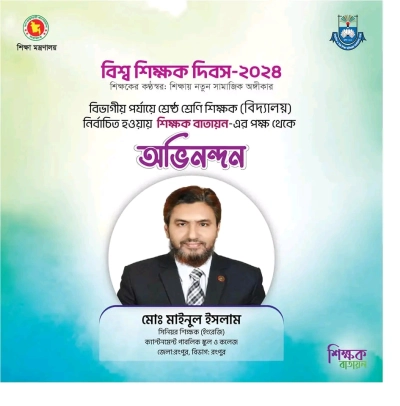
MD MAINUL ISLAM
সিনিয়র শিক্ষক


১৪ জানুয়ারি, ২০২৬ ০৮:০৪ অপরাহ্ণ
সিনিয়র শিক্ষক
A Unique and Intellectual Mentor with Versatile and Dynamic Excellence:
Reconceptualizing the Role of Teachers in Bangladesh
Md.
Mainul Islam
Senior Teacher
BA (Elective English), MA (English)
B. Ed (1st Class), M. Ed (1st Class)
Teachers’ Training College (TTC), Dhaka, Bangladesh
Abstract
Bangladesh, as a developing nation in South Asia, continues to face significant challenges in its educational system, particularly in terms of teacher quality, professional dignity, and societal recognition. Despite teaching being universally acknowledged as a noble profession, it remains undervalued both economically and socially. This conceptual research paper explores the philosophical, psychological, moral, and professional dimensions of a unique, dynamic, and intellectual teacher who can transform learners, institutions, and society. Drawing on symbolic interpretations of the terms Teacher, Student, and Education, and supported by global educational philosophies, this paper proposes a comprehensive framework of teacher qualities necessary for educational reform in Bangladesh. The study emphasizes devotion, ethical integrity, psychological understanding, lifelong learning, and visionary leadership as essential attributes of an ideal teacher capable of nation-building.
Keywords
Dynamic Teacher; Teacher Professionalism; Educational Philosophy; Teacher Quality; Educational Psychology; Nation Building; Teaching Ethics; Student-Centered Learning; Bangladesh Education System; Lifelong Learning
1. Introduction
Bangladesh is a relatively young nation whose educational system is still evolving amid social, economic, and global challenges. A significant portion of the population remains uneducated or semi-literate, while the teaching profession suffers from low remuneration, limited social status, and declining interest among talented graduates. Consequently, fewer qualified individuals are motivated to enter teaching, despite its foundational role in national development.
Education, however, cannot progress without competent, committed, and visionary teachers. As Malala Yousafzai rightly stated, “One child, one teacher, one book, and one pen can change the world.” This paper argues that the future of Bangladesh depends not merely on curriculum reform or infrastructure development, but on the emergence of dynamic and unique teachers who combine intellectual depth, moral character, psychological insight, and professional excellence.
2. Teaching as a Noble and Transformative Profession
Teaching is not a profession measured by monetary reward but by honor, dignity, and societal impact. An intellectual and multitalented teacher derives satisfaction from service, sacrifice, and student success. Mustafa Kemal Atatürk aptly observed, “A good teacher is like a candle—it consumes itself to light the way for others.”
A teacher’s role extends beyond content delivery to shaping character, cultivating values, and nurturing national consciousness. Therefore, teaching must be re-envisioned as a lifelong mission rather than a mere occupation.
3. Conceptual Symbolism of Teacher, Student, and Education
3.1 Symbolic Meaning of “TEACHER”
T – Talented / Tolerant
E – Excellent
A – Adorable
C – Charming
H – Humble / Honest
E – Encouraging / Educator
R – Responsible / Reliable
These attributes collectively define the moral and professional identity of an ideal teacher.
3.2 Symbolic Meaning of “STUDENT”
S – Study
T – Truthfulness
U – Unity
D – Discipline
E – Energetic
N – Necessity
T – Training
A profound teacher understands these dimensions and nurtures students accordingly.
3.3 Symbolic Meaning of “EDUCATION”
E – Enlightenment
D – Dutiful
U – Understanding
C – Careful
A – Active
T – Truthful
I – Intelligent
O – Ornament
N – Noble
Education thus becomes a holistic process of intellectual, moral, and social development.
4. Psychological and Pedagogical Foundations of Effective Teaching
A renowned teacher must possess deep understanding of multiple psychological dimensions, including:
Child psychology
Educational and learning psychology
Social and human psychology
Leadership and behavioral psychology
Environmental and moral psychology
Such knowledge enables teachers to respond effectively to diverse learner needs and classroom realities.
5. Core Characteristics of a Dynamic and Renowned Teacher
This paper synthesizes the qualities of an ideal teacher into the following key domains:
5.1 Professional Devotion and Ethical Integrity
A great teacher demonstrates unwavering commitment, honesty, fairness, and moral courage. Teaching is approached as a sacred responsibility rather than a transactional job.
5.2 Knowledge Mastery and Lifelong Learning
Teachers must possess deep subject knowledge, pedagogical competence, and a continuous desire to learn. As Socrates noted, “I cannot teach anybody anything; I can only make them think.”
5.3 Emotional Intelligence and Psychological Balance
Effective teachers manage emotions, handle stress, overcome depression, and maintain positivity, thereby modeling resilience for students.
5.4 Student-Centered Relationships
Strong rapport, empathy, love for children, and respect for individuality form the backbone of effective teaching. Students succeed when teachers believe in them.
5.5 Classroom Management and Instructional Planning
Clear objectives, fair assessment, disciplined environments, adaptive teaching strategies, and reflective practice ensure quality learning outcomes.
5.6 Communication, Humor, and Motivation
A sense of humor, clear communication, and authentic praise enhance student engagement and reduce anxiety.
5.7 Technological and Global Competence
Modern teachers must integrate ICT, adapt to global educational demands, and prepare learners for a rapidly changing world.
6. Avoidable Traits and Ethical Boundaries
An ideal teacher must strictly avoid:
Dishonesty and falsification
Bias, discrimination, and unfairness
Sexual misconduct and vulgarity
Intellectual negligence and misinformation
Rude, unethical, or unprofessional behavior
Ethical conduct safeguards both the dignity of the profession and the well-being of learners.
7. Teachers as Nation Builders in Bangladesh
Bangladesh urgently requires teachers who are willing to sacrifice comfort for commitment and personal gain for public good. A dynamic teacher prays, plans, perseveres, and persists for student success. As Nelson Mandela stated, “Education is the most powerful weapon which you can use to change the world.”
Teachers are architects of national consciousness, builders of human capital, and guardians of moral values.
8. Conclusion
Teaching is not merely a profession—it is a lifelong vocation of dedication, patience, sacrifice, and optimism. A dynamic and intellectual teacher embodies humility, wisdom, creativity, and global vision. The dignity and status of teachers in Bangladesh must be reevaluated and strengthened, as national progress depends directly on teacher quality.
When teachers are respected, supported, and empowered, they inspire future generations to pursue excellence and integrity. Ultimately, a nation rises or falls on the strength of its teachers.
References (Selected Quotations)
Atatürk, M. K. – A teacher is like a candle…
Dewey, J. – Education is life itself
Mandela, N. – Education is the most powerful weapon
Socrates – I can only make them think
Yousafzai, M. – One child, one teacher…
References
Atatürk, M. K. (1936). The role of teachers in nation building. Ankara: Turkish Historical Society.
Coelho, P. (1998). Veronika decides to die. New York, NY: HarperCollins.
Confucius. (500 BCE). The analects. Translated editions. Beijing: Foreign Language Press.
Dewey, J. (1938). Experience and education. New York, NY: Macmillan.
Franklin, B. (1750). Poor Richard’s almanack. Philadelphia: B. Franklin.
Frost, R. (1962). In the clearing. New York, NY: Holt, Rinehart and Winston.
Mandela, N. (1994). Long walk to freedom. London: Abacus.
Mead, M. (1970). Culture and commitment. New York, NY: Natural History Press.
Socrates. (Plato, trans.). (380 BCE). The Republic. London: Penguin Classics.
Wilcox, C. (2000). Teaching with heart. New York, NY: Teachers College Press.
Yousafzai, M. (2013). I am Malala. London: Weidenfeld & Nicolson.






১৩
১৮ মন্তব্য