
মোঃ আব্দুর রহমান
প্রভাষক

০৪ আগস্ট, ২০২৬ ১১:৪৩ অপরাহ্ণ
প্রভাষক
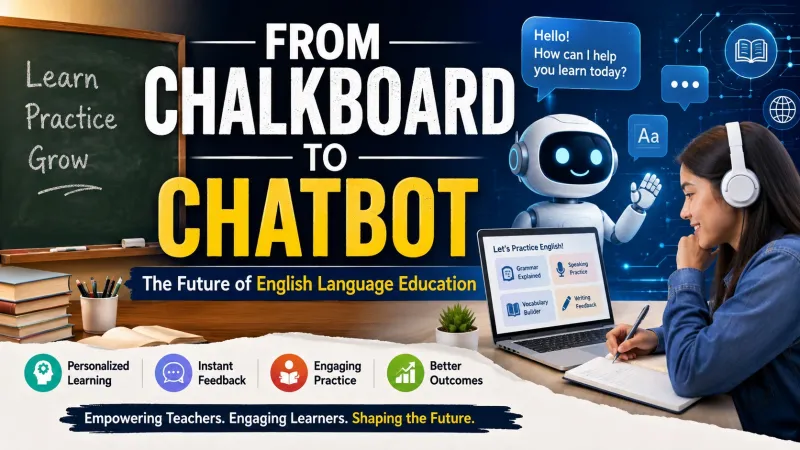
From Chalkboard to Chatbot: The Future of English Language Education
Introduction
Education has always evolved alongside technological progress. From chalkboards and printed textbooks to interactive whiteboards and online learning platforms, every innovation has transformed the way teachers teach and students learn. Today, the emergence of Artificial Intelligence (AI), particularly AI-powered chatbots such as ChatGPT, marks another significant milestone in this journey.
In English Language Teaching (ELT), AI is no longer a futuristic concept—it is becoming an essential educational companion. Rather than replacing teachers, AI has the potential to enrich classroom experiences, personalize learning, and prepare students for a technology-driven world. The future of English language education lies not in choosing between teachers and technology but in combining the strengths of both.
The Evolution of English Language Teaching
English language education has undergone remarkable changes over the past century. Traditional classrooms relied heavily on lectures, grammar drills, and memorization. Teachers used chalkboards to explain concepts, while students depended primarily on textbooks and notebooks.
The digital revolution introduced computers, multimedia projectors, language learning software, and internet resources. Online platforms enabled access to authentic materials, virtual classrooms, and global communication opportunities. Today, AI-powered tools represent the next phase of this evolution by providing intelligent, interactive, and personalized learning experiences.
What Is an AI Chatbot?
An AI chatbot is a computer program capable of understanding natural language and engaging in human-like conversations. Unlike traditional software that follows fixed instructions, modern AI chatbots learn from vast amounts of language data and generate contextually appropriate responses.
In English education, AI chatbots can:
These capabilities make AI chatbots valuable assistants for both educators and learners.
Benefits of AI in English Language Education
1. Personalized Learning
Every student learns differently. Some require additional grammar practice, while others need support with pronunciation or writing. AI can adapt activities according to learners' proficiency levels, learning pace, and individual needs, creating a more personalized educational experience.
2. Immediate Feedback
Traditional feedback often takes hours or days. AI provides instant responses to grammar exercises, essays, vocabulary tasks, and comprehension questions. Immediate feedback helps students identify mistakes and improve continuously.
3. Increased Student Engagement
Interactive conversations with AI encourage students to practice English without fear of embarrassment. Learners who hesitate to speak in front of classmates often gain confidence through private interactions with AI tools.
4. Support for Teachers
Teachers spend considerable time preparing lessons, designing worksheets, and grading assignments. AI can assist by generating lesson plans, discussion questions, quizzes, rubrics, and classroom activities, allowing educators to focus more on meaningful instruction and student interaction.
5. Enhanced Writing Skills
AI writing assistants can help students organize ideas, improve sentence structure, expand vocabulary, and identify grammatical errors. When used responsibly, these tools promote revision and deeper understanding rather than simple correction.
6. Learning Beyond the Classroom
AI-powered applications are available anytime and anywhere. Students can practice speaking, reading, writing, and listening outside classroom hours, making language learning more continuous and flexible.
The Changing Role of English Teachers
The rise of AI does not diminish the importance of teachers. Instead, it transforms their role.
Future English teachers will become:
Teachers provide empathy, emotional support, creativity, classroom management, cultural understanding, and moral guidance—qualities that AI cannot fully replicate.
Challenges and Ethical Considerations
Despite its advantages, AI also presents several challenges.
Academic Integrity
Students may misuse AI to complete assignments without genuine learning. Educational institutions should develop clear guidelines that encourage responsible AI use while maintaining academic honesty.
Digital Divide
Not all learners have equal access to reliable internet connections or digital devices. Ensuring equitable access remains an important challenge, particularly in developing countries.
Privacy and Data Security
Educational institutions must protect students' personal information and use AI platforms that comply with privacy regulations.
Accuracy of AI Responses
Although AI is highly capable, it can occasionally produce inaccurate or misleading information. Teachers should encourage students to verify information using credible academic sources and develop critical evaluation skills.
The Future Classroom
The classroom of the future will combine human expertise with intelligent technology. Teachers may use AI to:
Students, meanwhile, will use AI as a learning companion rather than a replacement for independent thinking. Success will depend on their ability to ask thoughtful questions, evaluate information critically, and apply knowledge creatively.
Implications for Bangladesh
Bangladesh is making steady progress toward digital education through government initiatives, improved internet connectivity, and increased adoption of educational technologies. Integrating AI into English language education can help address several persistent challenges, including large class sizes, limited instructional time, and varying learner proficiency levels.
However, successful implementation requires investment in teacher training, digital infrastructure, and AI literacy. Educational policymakers, institutions, and teachers must work together to establish ethical guidelines and promote responsible use of AI in classrooms.
Recommendations
To maximize the benefits of AI in English education:
Conclusion
The journey from chalkboard to chatbot represents more than a technological transformation—it reflects a fundamental shift in how languages are taught and learned. Artificial Intelligence offers unprecedented opportunities to personalize instruction, increase engagement, and enhance teaching effectiveness. Yet, technology alone cannot replace the inspiration, empathy, and professional judgment of dedicated educators.
The future of English language education will belong to teachers who embrace innovation while preserving the human values that define meaningful learning. By combining the strengths of experienced educators with the capabilities of AI, we can create classrooms that are more inclusive, engaging, and effective than ever before.
In this new era, the chalkboard and the chatbot are not competitors; they are partners in shaping the next generation of English language learners.






৬৪
১০০ মন্তব্য