
শ্রীমান কান্তি দাশ
সহকারী শিক্ষক

৩০ সেপ্টেম্বর, ২০২৬ ১২:৪৬ অপরাহ্ণ
সহকারী শিক্ষক
What is Everything Made Of?
Today, we’re going on an invisible microscopic journey inside Chapter 6 of our Class 8 Science NCTB book: Atomic Structure (পরমাণুর গঠন)!
Have you ever wondered what you, your phone, or this glass of water are made of? If we keep cutting matter into smaller and smaller pieces, what do we get at the end? Let's find out!"
The Idea of Atoms & Subatomic Particles:
The Idea of Atoms & Subatomic Particles:
"Ancient Greek philosopher Democritus first called these tiny indivisible particles 'Atomos' (meaning indivisible). Later, in 1803, John Dalton stated that atoms cannot be broken down further. But guess what? Science proved them partially wrong!
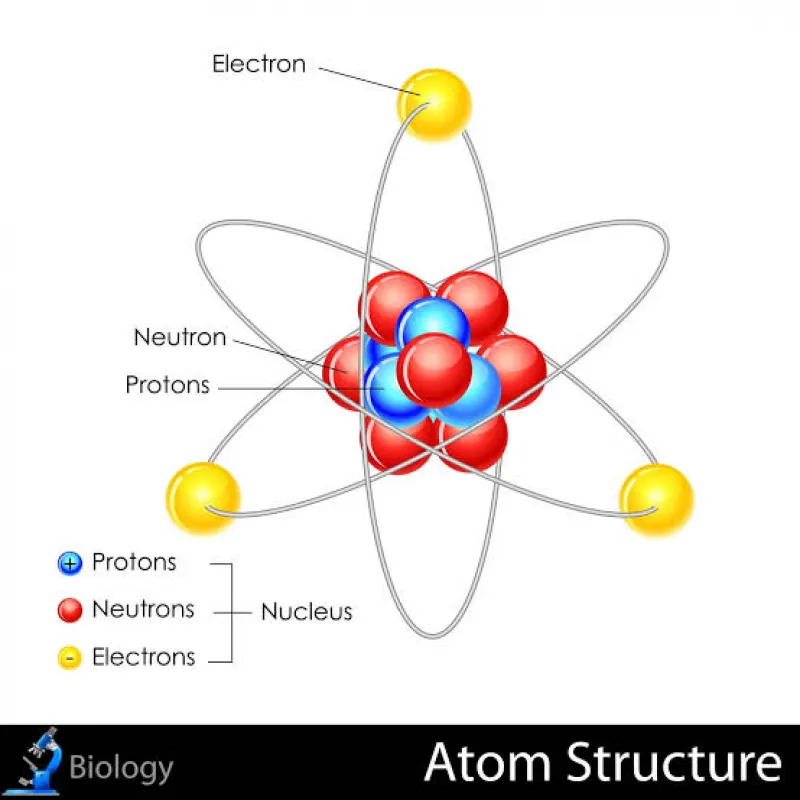
An atom can be divided into three primary fundamental particles:
Protons (P+): Positively charged particles sitting right in the center.
Neutrons (n0): Neutral particles (no charge) sharing space with protons.
Electrons (e-): Extremely tiny, negatively charged particles spinning around the outside!"
Atomic Models (Rutherford vs. Bohr)
"How do these particles arrange themselves? Two famous scientists gave us the best answers!"
"Ernest Rutherford compared the atom to our Solar System! He discovered that almost all the mass and positive charge of an atom is concentrated in a tiny central core called the Nucleus. Electrons orbit around this nucleus just like planets orbit the Sun."
"Niels Bohr fixed a major flaw in Rutherford's model. He explained that electrons don't just spin anywhere—they revolve around the nucleus in specific circular paths called orbits, energy levels, or shells (labeled K, L, M, N)."
[Visual: Text overlay with simple math graphics appearing on screen.]
Host:
"Now let's look at the numbers you must remember for your NCTB examAtomic Number (Z): The number of protons in an atom's nucleus. It defines the element! For example, Carbon has 6 protons, so its Atomic Number is 6.
Mass Number (A): The total number of protons + neutrons in the nucleus.
Formula to remember:
Number of Neutrons = Mass Number (A) - Atomic Number (Z)
Example: Sodium (Na) has a Mass Number of 23 and an Atomic Number of 11.
Electron Configuration & Chemical Activity
"How do electrons arrange themselves in shells? There's a rule: 2n2, where n is the shell number!
1st shell (K): Max 2 X 12 = 2 electrons
2nd shell (L): Max 2 X 22 = 8 electrons
3rd shell (M): Max 2 X 32 = 18 electrons





২
৫ মন্তব্য