
শিশির সরদার
সহকারী শিক্ষক

৩১ আগস্ট, ২০২৬ ০৩:৪৭ অপরাহ্ণ
সহকারী শিক্ষক
ধরনঃ সাধারণ শিক্ষা
শ্রেণিঃ নবম
বিষয়ঃ ভূগোল
অধ্যায়ঃ অধ্যায় ৬
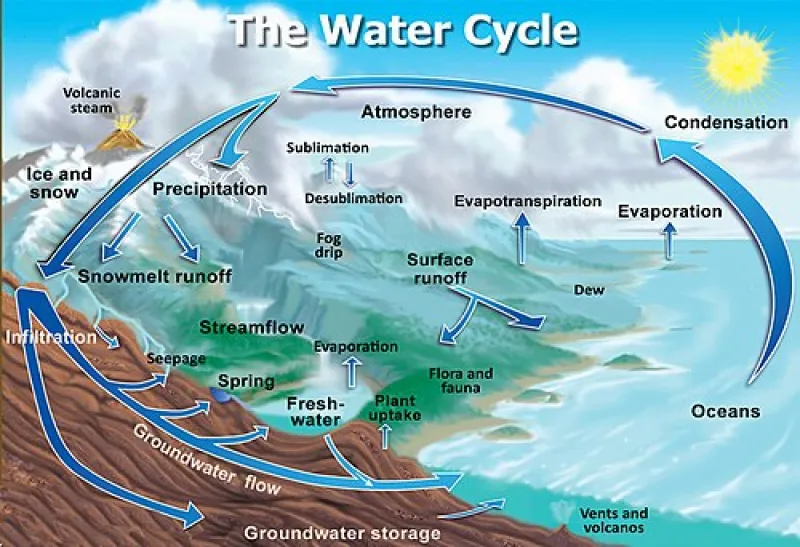
The water cycle refers to the transfer of water from one state or reservoir to another. Reservoirs include atmospheric moisture (snow, rain and clouds), streams, oceans, rivers, lakes, groundwater, subterranean aquifers, polar ice caps and saturated soil. Solar energy, in the form of heat and light (insolation), and gravity cause the transfer from one state to another over periods from hours to thousands of years. Most evaporation comes from the oceans and is returned to the earth as snow or rain.[12]: 27 Sublimation refers to evaporation from snow and ice. Transpiration refers to the expiration of water through the minute pores or stomata of trees. Evapotranspiration is the term used by hydrologists in reference to the three processes together, transpiration, sublimation and evaporation.[12]
Marq de Villiers has described the hydrosphere as a closed system in which water exists. The hydrosphere is intricate, complex, interdependent, all-pervading, stable, and "seems purpose-built for regulating life."[12]: 26 De Villiers claimed that, "On earth, the total amount of water has almost certainly not changed since geological times: what we had then we still have. Water can be polluted, abused, and misused but it is neither created nor destroyed, it only migrates. There is no evidence that water vapor escapes into space."[12]: 26
Every year the turnover of water on Earth involves 577,000 km3 of water. This is water that evaporates from the oceanic surface (502,800 km3) and from land (74,200 km3). The same amount of water falls as atmospheric precipitation, 458,000 km3 on the ocean and 119,000 km3 on land. The difference between precipitation and evaporation from the land surface (119,000 − 74,200 = 44,800 km3/year) represents the total runoff of the Earth's rivers (42,700 km3/year) and direct groundwater runoff to the ocean (2100 km3/year). These are the principal sources of fresh water to support life necessities and man's economic activities.[9]
Water is a basic necessity of life. Since two thirds of the Earth is covered by water, the Earth is also called the blue planet and the watery planet.[notes 1] The hydrosphere plays an important role in the existence of the atmosphere in its present form. Oceans are important in this regard. When the Earth was formed it had only a very thin atmosphere rich in hydrogen and helium similar to the presen


