Common Types of Pronouns
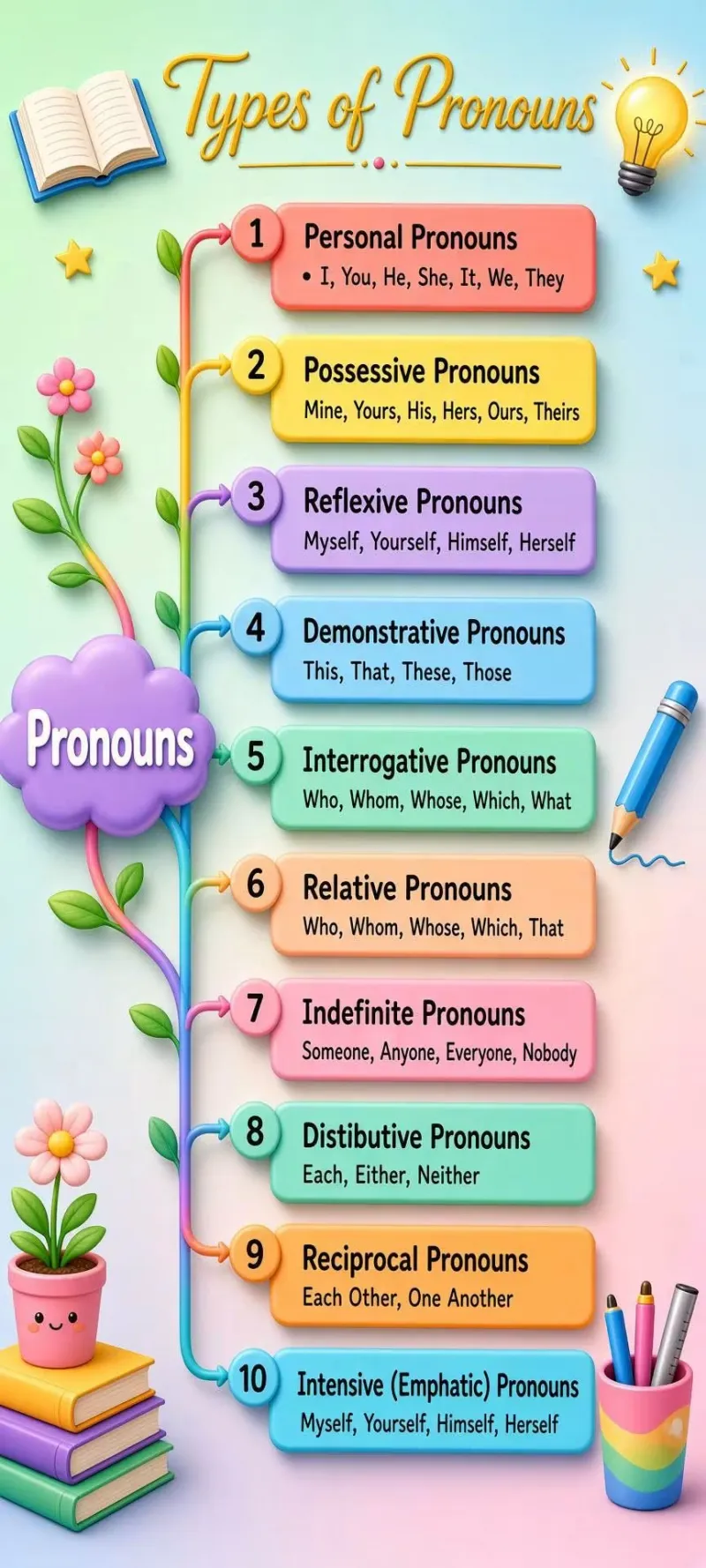
Personal pronouns: Replace specific people or things (examples: I, you, he, she, it, we, they).
Possessive pronouns: Show ownership or belonging (examples: mine, yours, his, hers, ours, theirs).
Reflexive pronouns: Point back to the subject of the sentence (examples: myself, yourself, himself, themselves).
Demonstrative pronouns: Point to specific items or people (examples: this, that, these, those).
Interrogative pronouns: Are used to ask questions (examples: who, what, which, whose).
Indefinite pronouns: Refer to non-specific people or things (examples: anybody, everyone, something, none).
Relative pronouns: Connect a clause or phrase to a noun or pronoun (examples: who, whom, whose, which, that).
Reciprocal pronouns: Express a mutual action or relationship (examples: each other, one another).